Back in the Playground: Marbles, Elastics and the Rhymes That Never Really Left
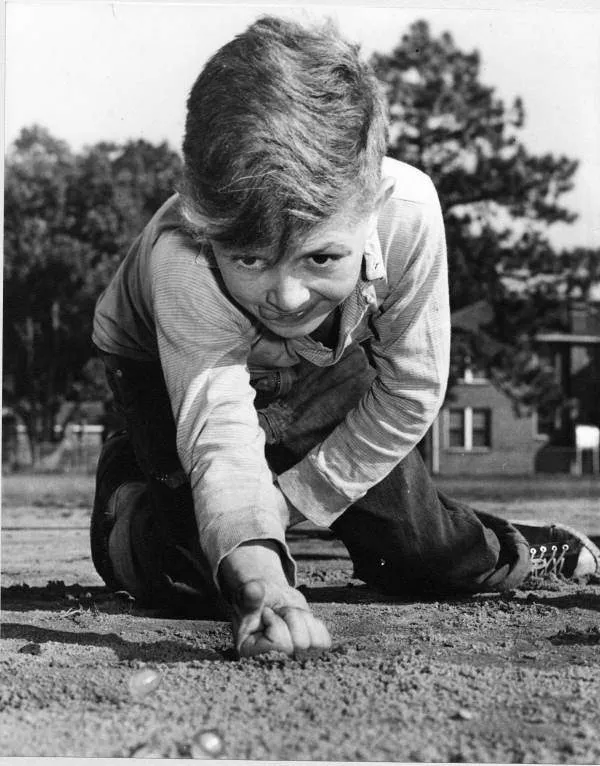
Photo: Florida Memory, Public domain, via Wikimedia Commons
There is a particular sound that a school playground makes when it is going well. It is not the sound of a whistle. It is the sound of about forty children chanting the same rhyme slightly out of time with each other while a rope slaps the tarmac.
If you have walked past the gates at breaktime lately, you will have heard it. The old games are back.
Why the old games came back
No one sat the children down and announced a revival. It happened in the way most playground trends happen: one person brought in a bag of marbles, someone else remembered a clapping rhyme from a cousin's birthday party, and within a fortnight the whole thing had spread like a rumour.
There were some gentle nudges from staff. Play leaders in Year 6 have been given a small budget for equipment, and a box of chalk, three long ropes and a jar of marbles now live in the shed by the field. Breaktime rules were adjusted so that the top yard could be used for games that need a flat surface and a bit of space.
But the real reason these games have stuck is simpler than that. They work. They need almost nothing, they do not require a screen, and — crucially — children of wildly different ages can play them together without anyone being officially in charge.
Marbles: the currency of the top yard
Marbles arrived first and have proved the most durable. There is now a permanent chalk circle drawn in the corner of the top yard, which staff have quietly stopped sweeping away.
How it works: each player puts a set number of marbles inside the ring. Players take turns flicking a 'shooter' from outside the circle, trying to knock marbles out. Whatever you knock out, you keep. It is simple, it is mildly ruthless, and it is extremely popular.
The school rule is that marbles played for are school marbles, kept in the shed. Nothing from home changes hands. This has prevented approximately nine thousand arguments.
What has surprised staff most is the trading. Marbles have developed a hierarchy, complete with rare 'glassies' that change hands at rates the children negotiate with total confidence and no reference to any economics textbook.
Elastics: knees, waists and the dreaded shoulder round
Elastics has returned with real enthusiasm. Two children stand with a loop of elastic around their ankles; a third jumps the sequence in the middle, chanting as they go.
The ladder: ankles, calves, knees, thighs, waist, and then — for the very brave — armpits and shoulders. Each round is a little harder, and the sequence of jumps has to be completed cleanly to move up.
The chant: most groups use a version of the classic 'England, Ireland, Scotland, Wales, inside, outside, inside, out' routine, though regional variations have crept in via grandparents and cousins from other parts of the country. Several children have strong opinions about which version is correct. None of them are willing to compromise.
Elastics has been a quiet win for the children who prefer smaller groups and a bit of rhythm to a full-pitch game of football.
Hand-clap rhymes: an oral tradition with a beat
Hand-clapping games have never entirely gone away, but this term they have multiplied. Small circles of children, mostly but not exclusively girls, are to be found clapping in pairs and fours, speeding up until somebody collapses in giggles.
The current favourites include 'A Sailor Went to Sea', a properly fast version of 'Miss Polly Had a Dolly', and a lengthy number about a young lady dressed in yellow that appears to have at least eleven verses and no end.
What is lovely about these is that they are genuinely passed on. Almost none of the rhymes were taught by an adult. They came from older siblings, from the year above, from holiday clubs. It is the closest thing to folk music you will find on a Tuesday lunchtime.
Skipping: the long rope revival
Long-rope skipping needs two turners, a flat bit of ground and a bit of nerve. A queue has formed for it nearly every breaktime since the ropes arrived.
Classics dominate: 'Teddy Bear, Teddy Bear', 'The Big Ship Sails on the Ally-Ally-O', and a fast one about a house that nobody can get past verse four without tripping. There are also, inevitably, a few improvised versions featuring the names of teachers.
Conkers: a short season, fiercely fought
Conkers had a brief but intense run in October. The school's approach is sensible: conkers must be collected from the ground, drilled by an adult, and played over a marked line with no swinging above the shoulder. No soaking in vinegar, no baking in the oven, no conker left overnight in a mysterious tin in a shed — all of which have been attempted, and all of which were quickly found out.
The season is over now, the last of them having gone soft and dull, but the champion of the autumn has been noted and will be remembered.
A quick-start guide for families
Fancy a go at home? A few pointers from the pupils themselves:
- Marbles — you need a flat surface, chalk, and a shooter per person. Draw a circle about 30cm across. Anything knocked out of the ring is won. Play for a set number of marbles so nobody loses everything on a bad day.
- Elastics — a length of elastic tied into a loop, about three metres. Two people stand inside. Start at the ankles. Move up a level once a full sequence is completed.
- Hand-clap rhymes — ask your child to teach you one. Expect to be bad at it. Expect to be corrected. Both are part of the process.
- Skipping — a rope long enough that two turners can stand comfortably apart. Turning, not swinging, is the skill to practise.
- Conkers — collect from the ground, drill by an adult, keep swings low and games short.
The rules of the yard
The unwritten code of the playground has been updated to include marble etiquette, and it is worth knowing: no snatching, no gloating, and no complaining about a lost marble for longer than the game lasts. Those are the rules. They are not up for negotiation.
The best bit about all of this is how little it cost. A few pounds of equipment, a bit of chalk and the willingness of staff to say yes to a slightly noisier breaktime. Not a bad return on investment.
If you find a glassy in a coat pocket while doing the washing this week, you now know exactly what it is worth. Apparently, quite a lot.