The Quietest Room in School Is Also the Busiest: A Term Behind the Library Desk
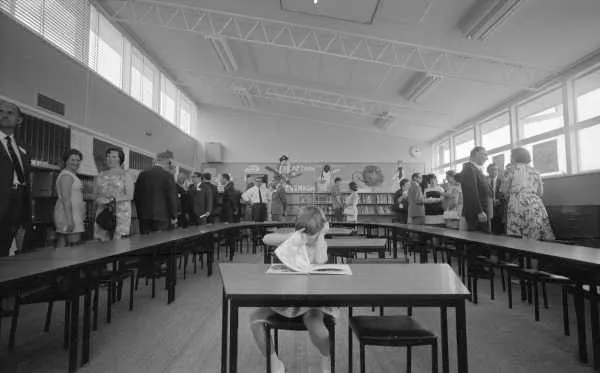
Photo: Dennis Mayor, CC0, via Wikimedia Commons
From the corridor, our school library gives very little away. There is a rug, some shelves, a window that catches the afternoon light and a desk that looks — at first glance — like the quietest spot in the building. Spend a term behind that desk, though, and a different picture emerges. The library is not a silent room with books in it. It is a working, talking, recommending, stamping, sorting, sometimes slightly chaotic social space, and it happens to have books at the centre of it.
A desk with a queue
Morning break is the first rush. Not every day, and not always at 10:30 on the dot, but often enough that the pupil librarians have learned to arrive a few minutes early. They put the returns trolley in position, check the date stamp is inked and make sure the “just back” shelf is clear. By the time the first class files past the window, someone is already asking whether the new dog book has come back yet.
Borrowing works in the straightforward way you would hope. Pupils choose a book, bring it to the desk, have it stamped and take it away. Returns go on the trolley. If a book is overdue, there is a gentle reminder rather than a grand inquest. The aim is to keep books moving, not to make anyone feel small about a title that has been under a bed since half term. The desk team are particularly good at this. They ask questions, make suggestions and occasionally talk someone into a book they had already decided they did not want. More often than not, that book is the one that leaves with them.
What goes out, what comes back
The borrowing pattern over this term has been revealing. Funny books travel fastest. Anything with a cartoon cover, a suspicious title or a character who is clearly about to make a bad decision will be gone by lunchtime. Fact books have a steady, loyal following — space, animals, volcanoes, anything with a cross-section. And there is a quiet appetite for stories about friendship and family that does not always show up in the obvious recommendations.
The returns tell their own story. Some books come back within days, clearly read from cover to cover. Others return after a term with a bookmark still in chapter three, which is not a failure so much as an honest record of a busy life. The pupil librarians have stopped judging either way. Their job is to get the next book into the next pair of hands, and they are remarkably unsentimental about it.
The wet-play corner
If you want to understand why the library matters, watch it on a wet playtime. The corner by the non-fiction shelves fills first. It has a rug, a few cushions and a low table that is usually covered in someone else’s half-finished drawing. Within ten minutes of a wet break being called, the room goes from peaceful to pleasantly full. There are children reading on the floor, children swapping books, children asking the pupil librarian whether there is anything about sharks that is not too long.
This is the part of library life that does not show up in the borrowing figures. The library is a warm, dry place to be when the playground is out of bounds. It is also a place where children who find the playground a bit much can sit without having to explain themselves. Nobody has to join in. Nobody has to be anything other than quiet for a few minutes. The books are the reason the room exists, but they are not the only reason children come in.
The pupil librarians
The desk is run by pupils, and that changes the atmosphere. They are not librarians in miniature. They are children with a job, and they take it seriously in the way children do — with a mixture of pride, mild bossiness and sudden, surprising kindness. They know which shelf the football books live on. They know which year group is currently obsessed with graphic novels. They know that the child hovering by the returns trolley probably needs help finding something rather than being asked twice what they want.
They also learn things that are hard to teach from the front of a classroom. How to ask a question that is not too pushy. How to listen to an answer that is not the one they expected. How to keep a queue moving without rushing anyone. How to recommend a book they loved without taking it personally when someone says no. These are small skills, but they add up to something bigger: a room where children are trusted to run something properly.
The books that never rest
There is a small shelf behind the desk for books that have just come back. It is supposed to be a temporary holding area. In practice, it is a recommendation engine. A child sees a classmate return a book and immediately asks for it. A cover catches someone’s eye. A title gets passed from hand to hand before it has even made it back to the proper shelf. The books that never rest are not always the ones adults would choose. They are the ones children hand to each other, which is a different kind of endorsement entirely.
Why a library is more than a room
By the end of the term, the library has done what good school libraries do. It has lent books, lost a few, found most of them again and provided a place to sit when the weather is grim. It has given pupil librarians a role that matters and given quieter children a corner that does not ask anything of them. It has turned borrowing into a habit rather than an event.
None of this happens by accident. It happens because someone keeps the shelves in order, because the desk is staffed by children who want to be there, and because the room is allowed to be a bit busy. The library is not the quietest room in school. It is one of the liveliest. And on a wet Tuesday in November, that is exactly what a school needs.