The Rail That Never Asks Why: One November Morning at the Uniform Swap
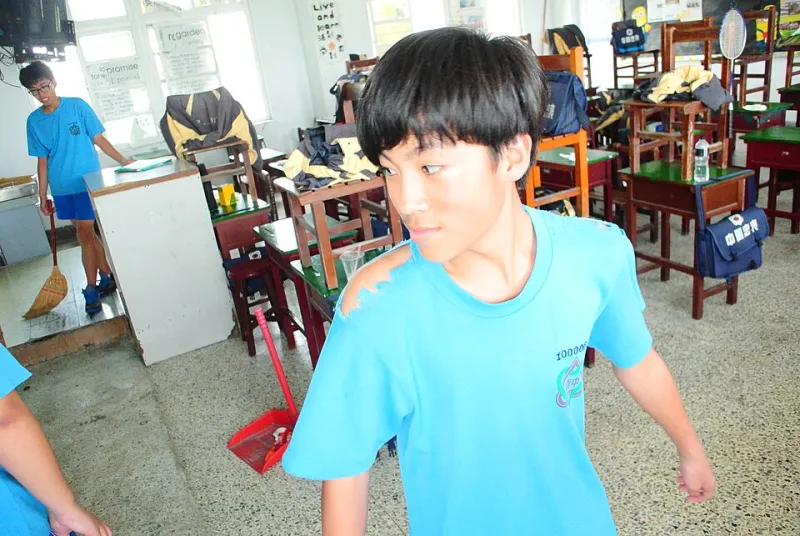
Photo: 褒忠國中 雲端網, CC BY 2.0, via Wikimedia Commons
It is 8:41 on a grey November morning and the rail by the office door is already doing its quiet work. A navy coat has gone out. Two pairs of grey trousers have come in. A volunteer is holding a small cardigan up to the light, checking a cuff, then reaching for the label gun.
The rail is the pre-loved uniform swap: a simple, volunteer-run fixture that has become part of the rhythm of Walberton & Binsted. No form. No queue. No questions. Just clothes that have done one job and are ready to do another.
A rail, a box and a rule
The set-up is almost aggressively ordinary. A grey clothes rail, a plastic box for donations, a stack of size labels, a mirror someone brought in from home. Behind it all is a rule that the volunteers repeat like a mantra: no name, no shame.
'That means what it says,' says one of the volunteers, straightening a row of jumpers. 'We do not want children walking about with someone else's name in their collar. We do not want anyone feeling they have to explain why they are here. And we do not want a big performance about giving, either. You bring what you can. You take what you need. That is it.'
By half past eight the rail has been sorted into rough size bands, with a small hook at the end for the odds and ends — a single glove, a book bag, a sun hat that has clearly been on an adventure.
What actually comes in
A typical morning's donations tell their own story. In one bag: a pinafore with a faded hem, a pair of shorts, and a jumper with the name carefully cut out. In another: a coat that has been worn hard and cleaned well, and a pair of wellies with plenty of mud still on them.
'That is fine,' the volunteer says. 'We would rather have it muddy than not have it at all. We wash what needs washing. Missing buttons get sewn. If something is truly past it, it goes to textile recycling, not the bin.'
Parents use the rail in different ways. One tells me she popped in after a growth spurt left her son with two pairs of trousers that fitted in September and none by October half term. Another says she takes a jumper at the start of every term because the school ones seem to shrink in the wash. A third says she donates because her daughter has strong opinions about cardigans and changes her mind weekly.
'It is not a big deal,' she says. 'That is the point. You just look, take what works, and get on with the school run.'
'Take what you need, bring what you can'
The volunteers are careful not to turn the rail into a lecture. Nobody is asked to justify a donation. Nobody is asked to prove a need. The only nudge is a small handwritten sign: 'Take what you need. Bring what you can. No name, no shame.'
A pupil in Year 4 tells me she found a cardigan with a dinosaur patch on the pocket. 'It is mine now,' she says, with the finality of a judge. 'I gave my old one back because it was too small. It is a fair swap.'
That phrase — a fair swap — comes up more than once. It captures the tone better than any policy document. The rail is not a charity drive with a clipboard. It is a neighbourly habit, kept going by a handful of people who would rather not be named and a school office that quietly clears space for it every week.
The awkward bit — and how the rail avoids it
The awkwardness around second-hand uniform is real. Some families worry about being seen. Some worry about taking something they do not strictly need. Some worry that donating a worn item looks mean.
The rail sidesteps most of this by being unremarkable. It is there every morning, next to the lost property box and the noticeboard. It does not advertise. It does not have a sign-up sheet. You can walk past it a hundred times and nobody will ask why you never stopped.
'If you want to be discreet, come early or come at pick-up,' says the volunteer. 'If you want to donate, put it in the box. You do not have to find someone and explain. We would rather you did not, actually. It keeps it normal.'
Practical ways to use it without making it weird
- Take what you need, when you need it. There is no booking system and no limit written down. If you need two jumpers, take two. If you need one, take one.
- Donate clean-ish, not perfect. Wash what you can. Missing buttons and small holes are fine. The volunteers will repair or pass on what is not right for the rail.
- Drop donations at the office door. Bags can go in the box by the rail. There is no form to fill in and no need to catch anyone's eye.
- Label removal is a kindness. If you can cut out a name before donating, do. If not, the volunteers will do it.
- Think beyond the jumper. PE kits, wellies, book bags, coats, pinafores, shorts and trousers all move quickly. Odd socks do not, but they are not turned away.
- Use it like a library, not a last resort. The families who use it most are not necessarily the ones in most need. They are the ones who have worked out that children grow and clothes do not.
What happens to what is left
At the end of the morning, the rail is thinner. The box has been emptied, sorted and restocked. Anything out of season goes into storage for the next growth spurt. Anything too worn goes to textile recycling. Nothing is thrown away if it can help someone else.
By 9am, the corridor is quiet again. The rail stands by the office door, patient as ever. It will be there tomorrow, and the morning after that, with its one rule and its quiet promise: no name, no shame. A fair swap, done often.